Cricket has been the game that glorifies elegance, timing, and technique. But there is nothing like pure pace to make a stadium jump. When a fast bowler runs in and throws a thunderbolt at more than 150 km/h it immediately causes a shift in momentum. In this comprehensive guide, we examine the fastest bowler of the world, the highest speed bowling records that have ever existed in the history of the sport and the bowlers who transformed the fast bowling concept with roughness and extreme sporting ability.
Our special attention is paid to proven speed records, official match statistics and historical comparisons. In addition, we also indicate organized ranking and revised analysis to enable the reader to have a clear picture of who really top the world fastest bowler ranking in international cricket.
World Fastest Bowler Ranking – Official Speed Records
Below is the verified ranking based on officially recorded top speeds in international cricket.
| Rank | Bowler | Country | Top Speed (km/h) | Speed (mph) | Year |
| 1 | Shoaib Akhtar | Pakistan | 161.3 | 100.23 | 2003 |
| 2 | Brett Lee | Australia | 161.1 | 100.14 | 2005 |
| 3 | Shaun Tait | Australia | 161.1 | 100.14 | 2010 |
| 4 | Jeff Thomson | Australia | 160.6 | 99.8 | 1975 |
| 5 | Mitchell Starc | Australia | 160.4 | 99.7 | 2015 |
| 6 | Andy Roberts | West Indies | 159.5 | 99.1 | 1975 |
| 7 | Fidel Edwards | West Indies | 157.7 | 98.1 | 2003 |
| 8 | Mitchell Johnson | Australia | 156.8 | 97.4 | 2013 |
| 9 | Mohammad Sami | Pakistan | 156.4 | 97.1 | 2003 |
| 10 | Shane Bond | New Zealand | 156.4 | 97.1 | 2003 |
This table clearly establishes the historical hierarchy within the world fastest bowler ranking and highlights the dominance of Australian and Pakistani fast bowlers in the speed category.
World Fastest Bowler Ranking – Shoaib Akhtar’s Historic Record
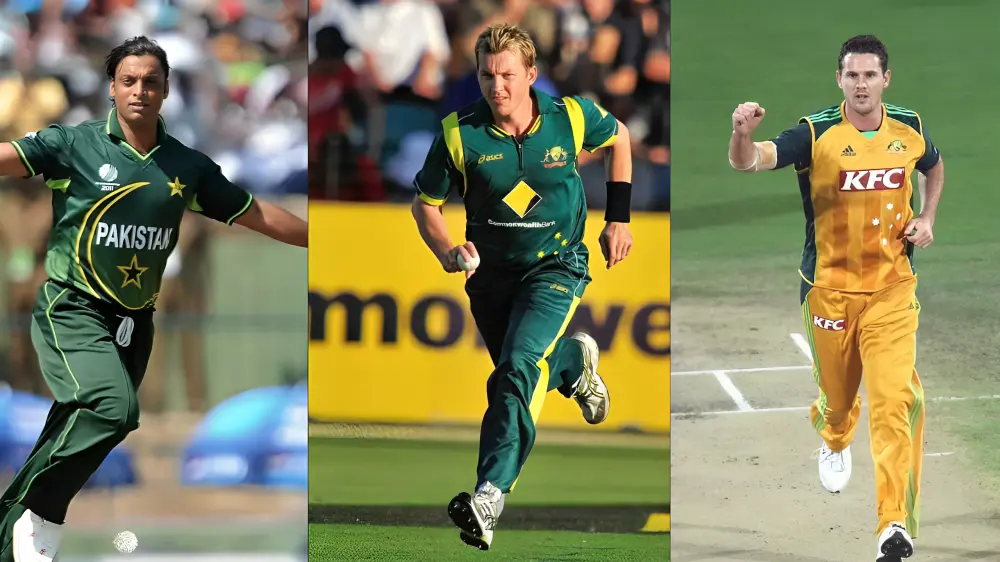
On the top of the fast bowler we have Shoaib Akhtar. In 2003, he hit England with a 161.3 km/h long ball at the 2003 Cricket World Cup in Cape Town. That delivery was an official record of 100 mph, and this record had not been even broken by any other bowler in the international form of the game of cricket.
Akhtar used explosive run-up acceleration, together with a strong bowling action. His pace in the career had been well above 150km/h. Due to that sustained speed, he was dubbed with the title of Rawalpindi Express.
The record of his accomplishment has remained to mark the pace of the fastest bowler in the world recordings.
World Fastest Bowler Ranking – Brett Lee and Australian Pace Legacy
Brett Lee is second in the list of fastest bowlers in the world at a speed of 161.1km/h. Lee did not bow at very high speeds like most of the pure speed bowlers; he was able to control the swing and the speed. In turn, he had sustained international careers in the formats.
Lee was a consistent over achiever (an average of over 150 km/h) and was a very aggressive bowler who put pressure on batsmen in both Test and ODI matches. Moreover, the culture of fast bowling in Australia promoted the high-speed competition which also gave birth to Shaun Tait and Mitchell Starc.
The constant appearance of Australia in the global fastest bowler list proves the fact of the system of the fast-bowling development in the country.
World Fastest Bowler Ranking – The Fear Factor of Shaun Tait
Shaun Tait had a speed of 161.1 km/h similar to Brett Lee. His bowling style was however quite different. Tait had offered bursts of high speed, principally in the limited overs game. His career had to be cut short by injuries, but his top speed is legendary.
His stingy pose created hard bang and uncertain motion. This made batsmen to have difficulties with timing his deliveries.
Tait is explosive speed in its clearest manifestation in the world fastest bowler ranking.
World Fastest Bowler Ranking – The 1970s Speed Era
The pace revolution of the 1970s was carried by Jeff Thomson and Andy Roberts. Thomson took 160.6 km/h which was not as advanced in speed technology. Most scholars are of the opinion that he might even have bowled faster than what has been recorded in records.
Tactical fast bowling that combined pace and deception was introduced by Andy Roberts. Their times put up fear as one of the strategic weapons of cricket. They gained strong market positions in the world ranking of the fastest bowlers in history even without modern equipment.
Fastest Ball in Test Cricket History
In spite of the fact that limited overs cricket normally brings in faster speeds, Test cricket requires endurance of speed during long periods. The 161.3 km/h of Shoaib Akhtar is also the fastest officially recorded ball in Tests.
Mitchell Starc trails behind with 160.4km/h. He has great potential to swing the ball with high speed hence he is one of the most dangerous modern pacers.
Thus, the Test format continues to add a lot of credibility to the world fastest bowler ranking.
How Speed Measurement Works in Modern Cricket
The radar guns, Hawk-Eye, and ball-tracking technology help the cricket authorities to measure the speed accurately. This is done by the calculation of velocity as soon as the ball is released.
The current digital tracing provides valid data collection. This has made the current standings of the fastest bowler ranking in the world correct and testable.
Can Anyone Break the 161.3 km/h Barrier?
It is common to find many fast bowlers today hitting over 150km/h. Nevertheless, it takes great biomechanics, strength, and endurance to be able to break 161.3 km/h.
Science of training is still developing. The new fast bowlers make use of sophisticated strength training, rest conditioning, and motion scanning. Thus, there is still a realistic chance of new record.
However, until a person exceeds that mark, Shoaib Akhtar is firmly holding his first place in the list of the fastest bowlers in the world.
World Fastest Bowler Ranking – Impact on Modern Cricket
Excessive speed variations are coordinated with dynamics in real time. Batsmen react later. Field placements are also adaptable. In addition, the psychological pressure is intensified significantly.
The world fastest bowler ranking features fast bowlers who tend to affect the strategies of the team. They are used to sever alliances and take over essential stages by captains.
Therefore, pace is still among the most useful tools of tactic in the game of cricket.
Prediction: Champions Trophy 2025 Fastest Ball
In future, bowlers such as Mitchell Starc and up-and-comers express pacers will break the speed limits. The current training enhances strength production and speed of recuperation.
Even though it is more presumptive to make the speculations, it is likely that crossing 160km/h could be achieved in the coming tournaments.
The world fastest bowler award can soon be renamed to include a new name at the top should things go right.
Final Thoughts on World Fastest Bowler Ranking
The history of fast bowling indicates development, boldness, and physical perfection. Whether it is the terrifying spells of Jeff Thomson or the 100 mph mark made by Shoaib Akhtar, speed remains the most exciting part of the game of cricket.
At present, the highest delivery of 161.3 km/h by Shoaib Akhtar is uncontested. Close behind are Brett Lee and Shaun Tait. In the meantime, the contemporary bowlers are pressing limits.
With the development of cricket, new players are bound to emerge. To this point, the official world fastest bowler list is a monument to the fastest bowlers the game has ever seen.
Read More Blogs :- Fastest Ball in Cricket History: 161.3 km/h Record