Have you ever been playing a match and wondered why you could not get your shots to fall in? Or perhaps you were not quite sure which side to be on in serving. These issues normally occur when the players are not well aware of the badminton court size in feet. As soon as you have the real dimensions in mind, you get a sense of confidence. You shoot better, pass smarter, and make better shots.
This stepwise documentation will tell you all about badminton court size in feet, length, width, service lines, height of the net and safety space. In addition, you will know how these measurements have a direct influence on your performance. You will not be taught uselessly how to memorize numbers, but you will understand the significance of each line on the court in the strategy.
The Badminton World Federation has international standards of badminton. These pro measurements are used globally, whether playing on a casual basis or as a professional. Thus, it is important to know how to play them properly should you wish to become a better gamer.
Official Badminton Court Size in Feet for Singles and Doubles
The size of the official badminton court in feet is the same in all tournaments and competitive matches. The court is a rectangle that is subdivided into an equal net. Despite the fact that the same court is used in singles and doubles matches, the width in which the game is played alters a bit.
Total Court Length
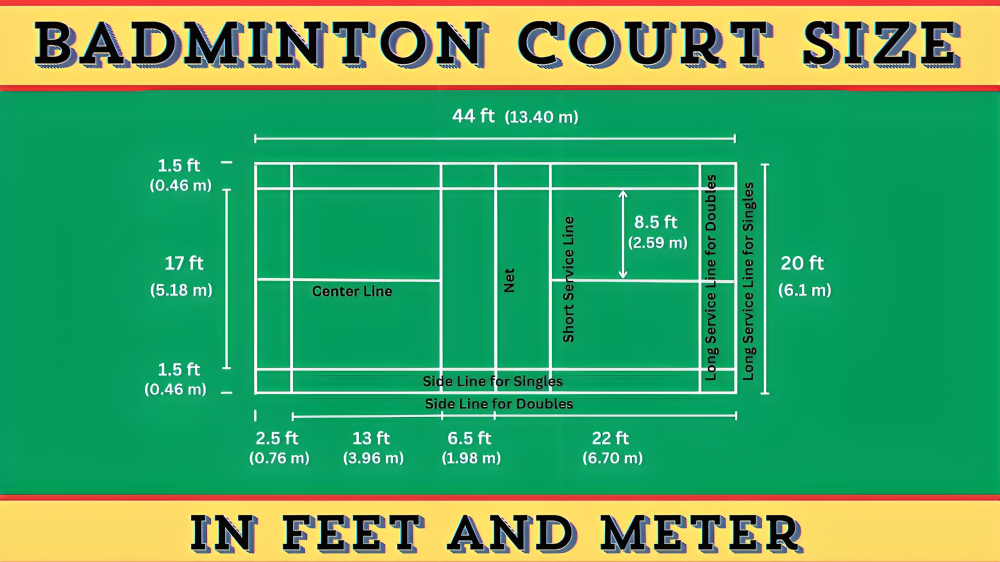
The court is all the way along a baseline 44 feet. This does not fluctuate in singles and doubles. Due to this predetermined length, the players should learn long clears and deep smashes. When you know the distance, you are able to make your opponent move to the back and also you are able to master on rallies.
Court Width for Doubles
In case of doubles, it is 20 feet wide. The outer most line is used by players. Consequently, the court expands and players have to run over a larger distance horizontally. Doubles games tend to be quicker due to this extra width.
Court Width for Singles
When playing singles, it is narrowed to 17 feet. Gamers make use of the interior lines rather than the exterior. This makes the court narrower thus requiring superior accuracy and sharp angles. The width is still 44 feet, but it becomes shorter, altering the whole plan.
In order to be more precise, a simple table explaining the major measurements is provided.
Standard Court Measurement
| Court Element | Measurement in Feet |
| Total Length | 44 feet |
| Width (Doubles) | 20 feet |
| Width (Singles) | 17 feet |
| Short Service Line Distance | 6.5 feet from net |
| Net Height (Center) | 5 feet |
| Net Height (Sides) | 5 feet 1 inch |
| Doubles Long Service Line Gap | 2.5 feet inside baseline |
Understanding the Layout Through Badminton Court Size in Feet
Now that you know the basic dimensions, let us break down the lines and zones. Every line has a purpose. Nothing appears randomly on a badminton court.
The Baselines
The baselines mark the back boundary of the court. They sit exactly 44 feet apart. During singles play, serves can reach this line. However, in doubles serving, a different rule applies, which we will explain shortly.
The Side Lines
There are two sets of side lines:
- Outer lines for doubles (20 feet width)
- Inner lines for singles (17 feet width)
This difference creates tactical variation between singles and doubles matches. Therefore, when you practice, you should always confirm which format you are playing.
The Short Service Line
The short service line is 6 feet 6 inches off of the net. A serve has to cross this line. When it lands prior to crossing it, then the serve is considered illegal. Due to this rule, the players are not allowed to execute very short serves that provide unfair advantage to them.
The Center Line
The middle of the line splits every half of the court into a left service box and a right service box. Players have to serve at diagonals. This line guarantees equitable and ordered rotation of serves.
The Long Service Line goes Doubled

Here is a very significant point. The long service line is not in contact with the baseline in doubles matches. Rather it is 2 feet 6 inches in the back boundary. As such, doubles players will not be able to serve to the rear line.
This change causes doubles serving to be more strategic. Gamers should pay attention to positioning as opposed to brute strength.
Net Height and Vertical Space Requirements
While people often focus only on floor measurements, vertical space also matters. The net height remains consistent worldwide.
- At the center, the net height measures 5 feet.
- At the posts on the sides, it measures 5 feet 1 inch.
This minor curve is a deliberate one. Even in singles matches, the net posts will be on the doubles sidelines. Consequently, tension remains level in any format.
Also, significant contribution is made by ceiling height. The recreational courts are supposed to be of a minimum of 20 feet of vertical clearance. The professional courts normally offer between 30 and 40 feet. Lack of height will cause the high clears to strike the ceiling and break the action.
Why Knowing Badminton Court Size in Feet Improves Your Game
Measurements are disregarded by many beginners. Nevertheless, professional players will never forget the size of the badminton court in feet. Knowledge of dimensions enhances intelligent gameplay.
Better Shot Placement
You make perfect shots when you have precise distances. You do not guess at which level the foundation is; you see it. As a result, you have more accurate clears and smashes.
Smarter Movement
Footwork becomes much better when you know about spacing. You come to know how many steps you take to reach any corner to the center court. Thus you save energy and respond to quicker actions.
Improved Serving Accuracy
Serving requires precision. When you are judging inaccurately the length of the service box, then you are losing points very easily. But when you fully comprehend the size of the badminton court in feet, then you serve nearer to boundaries and you cross them.
Tactical Advantage
The court is divided into zones by professional players mentally. They charge vulnerable points and bring opponents in challenging situations. When dimensions are clear in your mind then this strategic thinking becomes real.
Courtroom Safety Space
Besides the formal court markings, the additional area surrounding the court is necessary. Experts suggest a minimum of 5 feet of open space around the entire sides. This overflow zone takes away accidents during speedy rallies.
Shuttles are usually pursued by players along boundaries. In the absence of safety space, collisions can take place. As such, the correct planning of layout safeguards those concerned.
Space Around the Court for Safety
The size of badminton court in feet is the direct factor that influences the strategy in both formats.
The small width in singles promotes straight clears and cross drops. Footwork and stamina are very important to the players.
The larger court in doubles encourages angled shots and interceptions. There are front and back court positions which are divided by teams. Due to the reduced doubles service line, the serves are more tactical and controlled.
Differences Between Singles and Doubles Strategy
Suppose you were standing at the heart of your side. You look ahead and the net is just 22 feet ahead. There is another 22 feet of baseline behind you. On both sides, there is an extension of space to 8.5 feet (singles half-width) or 10 feet (doubles half-width).
As soon as you clearly visualize these numbers, the court is no longer a random line, but a strategic map. You begin to reason in terms of distances as opposed to making hasty judgments.
Practical Example: Visualizing the Court
Some non-professional players misinterpret some measurements. Others are of the view that singles and doubles have the same full width during serving. Others will forget that doubles serving does not go up to the back baseline.
These small misunderstandings cause unnecessary faults. Therefore, reviewing the official badminton court size in feet helps avoid simple mistakes that cost points.
How to Measure a Court Correctly
If you plan to mark your own court, follow these steps:
First, measure 44 feet in length using a reliable measuring tape. Mark both baselines clearly. Next, measure 20 feet for doubles width. After that, mark inner lines at 17 feet for singles.
Then, measure 6 feet 6 inches from the net to draw the short service line. Finally, mark the doubles long service line 2 feet 6 inches inside the baseline.
Such little misunderstandings create unnecessary faults. Thus, it is possible to review the official badminton court size in feet to prevent simple errors that result in loss of points.
How to Measure a Court Correctly
You have to mark your own court, so you can mark it as follows:
To begin with, the length of the new siding is to be measured at 44 feet with the help of the good measuring tape. Mark both baselines clearly. The second one is to measure 20 feet doubles width. Thereafter, single lines are marked at 17 feet.
Next, 6 feet 6 inches away on the net to short service line. Lastly, indicate the doubles long service line 2 feet 6 inches within the baseline.
Final Thoughts
The knowledge of badminton court size in feet alters your approach to the game. You are not acting without intent, but acting intentionally. You are smarter in your service, efficient and focused.
These dimensions should be shewn by heart by every serious player. The court is not merely a rectangle; it is a battlefield with structure in which strategy is the determining factor. As soon as you become familiar with the space, you have the control of the game.
Having the official measurements now in clear knowledge, take it to the next practice session. Shoot, count shots, touch the difference in your performance.
Read More Blogs:- What Is Bazball? England’s Fearless Cricket Revolution